What the F**k is DSA? (And Why You Are Already Using It)
Confused by the DSA hype? This guide cuts through the noise, explains what Data Structures and Algorithms actually are, and why you (unconsciously) use them every day.

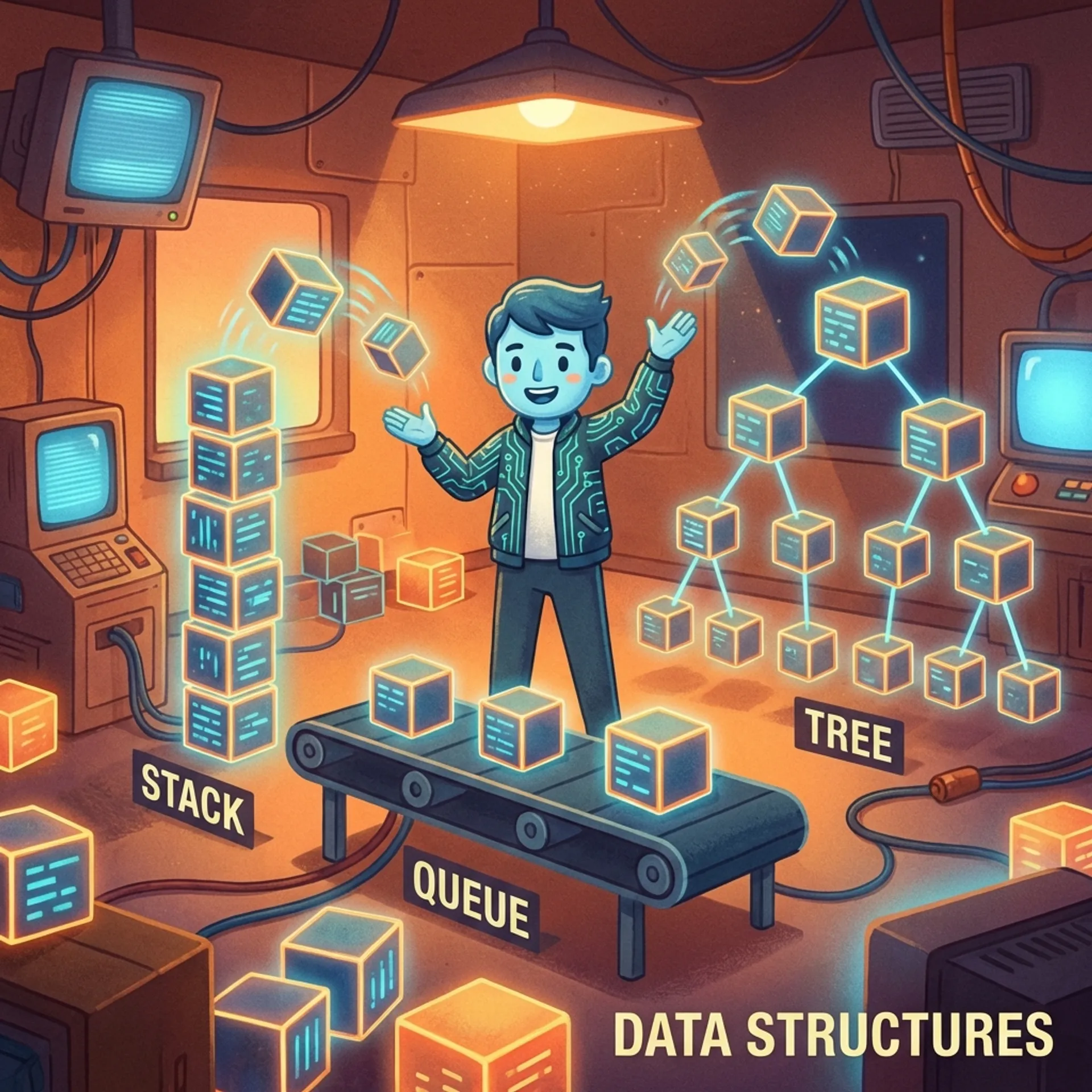
Open YouTube. Search for “Software Engineering.” What do you see?
“How I cracked Google with 500 LeetCode problems” “Master Dynamic Programming in 10 hours” “Why you will INVALID if you don’t know Binary Trees”
If you are a student or a self-taught developer, this is terrifying. It feels like there is this secret club called “DSA” (Data Structures and Algorithms), and if you don’t have a membership, you are not a “real” programmer.
You look at your simple To-Do List app built with React, and you think: “Wait, I didn’t use a Linked List here. Am I a fraud?”
Let me stop you right there.
I am going to tell you the truth about DSA. No academic jargon, no complex mathematical notation. Just raw, honest engineering.
What Actually is “DSA”?
It sounds like a scary medical condition. But break it down.
1. Data Structures (Organizing Stuff)
Imagine you have a messy room. You have clothes, books, and cables everywhere.
- If you throw everything in a pile -> That’s an Array (ish). Easy to throw things in, hard to find your left sock.
- If you stack books on top of each other -> That’s a Stack. You can only take the top book off.
- If you put clothes in categorized drawers -> That’s a Hash Map. You know exactly where the “Socks” drawer is.
A Data Structure is just a fancy way of saying: “How do we organize our data so we can use it easily?“
2. Algorithms (Doing Stuff)
Now that your room is organized, you need to find your red t-shirt.
- Algorithm A: Pick up every single piece of clothing one by one until you find it. (This is Linear Search). It’s slow and stupid.
- Algorithm B: Go to the “T-Shirts” drawer, look at the color tags, and grab the red one. (This is closer to Binary Search or Hashing). It’s fast and smart.
An Algorithm is just a step-by-step recipe to solve a problem.
DSA = Organizing Data + Processing Data. That’s it. That is the big secret.
You Are Already Using DSA (Without Knowing It)
This is the part that blows minds. You think you don’t know DSA because you haven’t inverted a Binary Tree on a whiteboard. But if you have built any web application, you are using DSA. You just call it something else.
The “Back” Button = A Stack
Open your browser. Click a link. Click another. Now click “Back”. How does the browser know where to go? It uses a Stack (Last-In, First-Out).
- You visit Page A. Browser pushes A to the stack.
- You visit Page B. Browser pushes B to the stack.
- You hit Back. Browser pops B off, and shows you A.
You use a Stack every day.
The Printer = A Queue
You send a document to print. Your colleague sends one 10 seconds later. Who gets printed first? You do. Because the printer uses a Queue (First-In, First-Out). The first job in is the first job out.
The DOM = A Tree
Are you a frontend developer? Do you write HTML?
<div>
  <h1>Hello</h1>
  <p>World</p>
</div>
That div is a parent. h1 and p are children.
Congratulations, you are working with a Tree data structure.
When you use document.getElementById, you are searching through that tree. When you use React’s Virtual DOM, you are diffing two trees to find changes.
JSON Objects = Hash Maps
Do you use JavaScript architecture?
const user = {
  id: 1,
  name: "Sariful",
  role: "Developer"
};
That object? That is a Hash Map (or Hash Table).
You give it a key (name), and it instantly gives you the value (Sariful). You don’t have to search through a list of users. You just go directly to the address. It is the most powerful data structure in the world, and you use it every time you write a line of JSON.
Google Maps = A Graph
When you ask for a route from Kolkata to Mumbai, how does it know the way? It uses a Graph data structure (Nodes = Cities, Edges = Roads). It runs a “Shortest Path” algorithm (like Dijkstra’s) to find the fastest route. You aren’t coding this daily, but you are using the concept every time you design a database relationship schema.
Why the Hype? (The “FAANG” Trap)
If DSA is just “organizing stuff,” why do interviews treat it like rocket science? Why do you need to know how to “balance a Red-Black Tree” to center a div?
Two reasons:
1. The Filter (The Game)
Google gets 3 million applications a year. They cannot interview everyone. They need a filter. DSA problems are hard. They act as an IQ test + Grunt Work test.
- Can you think logically?
- Are you disciplined enough to study boring stuff?
If you pass, they hire you. Does it mean you will use Dynamic Programming to build a button? No. It means you are smart enough to figure things out. It is a game. If you want to work at FAANG, play the game. But remember what I wrote in Future of Programmers: soft skills and product thinking are what will actually keep you employed in the long run.
2. Scale (The Real Engineering)
This is the valid reason. If you are building a Todo app for yourself, you have 10 items.
- Linear Search (checking one by one) takes 0.00001 seconds.
- Binary Search takes 0.000005 seconds. Nobody cares.
But if you are building Facebook, and you have 3 billion users.
- Linear Search takes days.
- Binary Search takes milliseconds.
At scale, efficiency is money. Bad code scaling burns millions of dollars in server costs. That is why Netflix and Uber care about DSA. They aren’t trying to be annoying; they are trying to save physics (and money).
Real vs. Fake DSA Learning
I see so many students getting stuck in “Tutorial Hell.”
Fake Learning:
- Memorizing code for 100 sorting algorithms.
- Grinding LeetCode just to get a green tick.
- Copy-pasting solutions without understanding why.
Real Learning:
- Understanding when to use an Array vs a Linked List.
- Knowing why your database query is slow (hint: it’s probably missing an Index, which is a B-Tree).
- Realizing that
nested loopsusually mean $O(n^2)$ complexity, which will crash your browser if the data gets big.
If you want to start learning web development properly, check out my Beginner’s Guide to see how these concepts fit into actual coding.
The Roadmap: What Should You Actually Learn?
Don’t try to learn everything. If you are a web developer, focus on these essential concepts. I dive deeper into necessary skills in my post about 5 Essential Skills for a Successful Career.
- Big O Notation: Just understand the difference between $O(1)$ (instant), $O(n)$ (linear/slow), and $O(n^2)$ (very slow).
- Arrays & Strings: Master manipulation.
map,filter,reduceare your best friends. - Hash Maps: Understand why looking up a key in an object is faster than finding an item in an array. Mini-project: Build a URL shortener logic.
- Trees: Understand the DOM and how nested data works. Mini-project: Build a nested comment section.
Ignore the crazy stuff (Graphs, Dynamic Programming, Bit Manipulation) until you actually need them or are interviewing for a role that explicitly asks for them.
Conclusion
DSA is not magic. It is not an IQ test. It is simply a toolbox. A carpenter has a hammer, a saw, and a drill. A programmer has Arrays, Stacks, and Hash Maps.
You don’t need to be a master of the drill to build a birdhouse. But if you want to build a skyscraper, you better know how your tools work under pressure.
Don’t let the hype scare you. You are probably researching and using DSA right now without even realizing it. So, take a breath. You’re doing fine.